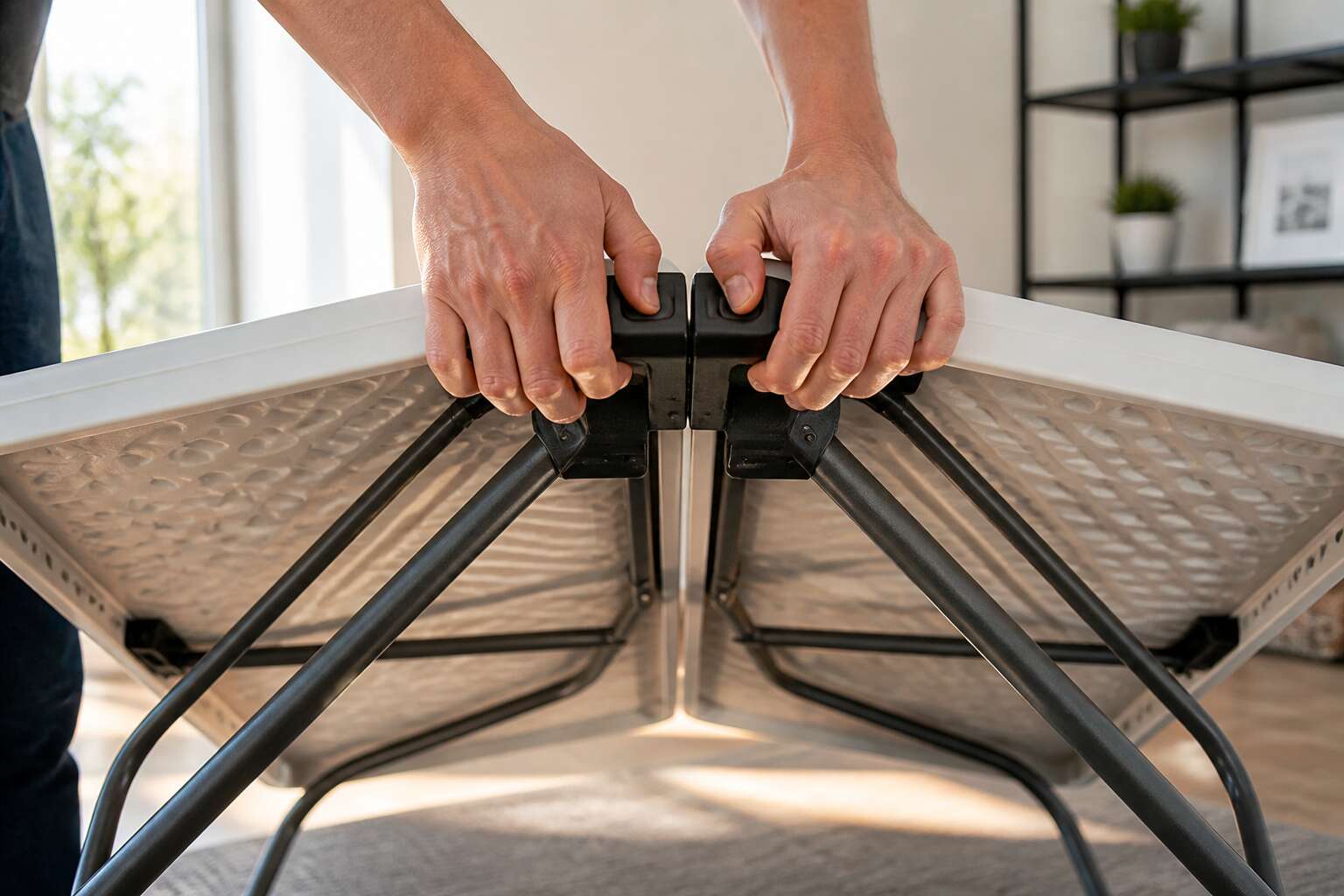
Understanding Your Folding Table Mechanism
Different Types of Folding Tables
Understanding how close folding table mechanisms work begins with the locking hinge. Most South African households use either a scissor frame or a sliding latch system. The scissor frame compresses evenly, while the sliding latch requires a firm push to disengage. Getting this wrong is why so many tables collapse mid-use.
Different types of folding tables add another layer of complexity. For instance:
– Banquet tables feature a torsion bar that snaps into place.
– Picnic tables rely on a pull-pin mechanism.
– Utility tables use a cam lock that twists sideways.
Each demands a specific sequence. Knowing which type you own changes how close folding table operations should be handled. A torsion bar resists sudden pressure, while a cam lock needs gentle alignment. The resistance you feel reveals exactly which mechanism is in front of you.
Locating the Locking Mechanism
The resistance you feel also reveals where to search. Locating the locking mechanism is a quiet ritual of touch. Run your fingers along the underside of the frame, moving past the legs until you find a cold metal outline. Most owners look at the top surface and miss the obvious. The latch never announces itself. How close folding table operations begin with this act of discovery, not with force.
- A stiff tongue suggests a spring loaded catch.
- A loose toggle points to a gravity lock.
- A silent button may require a long press.
Listen for the click. That sound marks the mechanism’s surrender. The frame will not collapse until you locate the precise pressure point. South African homes with wooden floors amplify every creak, so probe gently. Only then does how close folding table routines settle into a calm, predictable motion.
Recognizing Safety Latches and Release Buttons
Safety latches hold the frame’s position until you press the release button. That button sits flush with the hinge, its travel short and definite. Some latches respond to a sliding thumb, others to a direct press.
Knowing how close folding table mechanisms behave allows you to trust the hardware. I have freed more than one sticky button with a wet cloth and a dry rag. The click of the latch is a signal. Recognize that click and the table unfolds without resistance.
Checking for Obstructions or Damage Before Folding
Run your palm along the underside before pressing anything. A pencil, a stray cable, or a biscuit crumb can jam a folding mechanism. The release button may click cleanly while the frame refuses to move. That tells me: grit, sometimes a bent edge.
Check the hinge line and sliding track for damage before you commit to closing. Look for a burr on the metal, a cracked weld, or a screw that has worked itself loose. If the legs fold unevenly, stop.
- Clear the floor of anything that could catch under the frame.
- Wipe the pivot points with a dry cloth to remove dust.
- Listen for a scrape as you bring the halves together.
The way how close folding table legs approach each other should feel steady. A sudden hitch means something is caught. Lift the table to ease the weight, then let the pivot work. Do not force it!
Preparing the Table for Folding
Clearing the Table Surface Completely
Before you attempt to learn how close folding table, the tabletop must be completely clear. Every stray object can block the folding path. I always check for small items like pens, cutlery, or papers that might slip into the hinge cavity.
When clearing, focus on these zones:
- The central span where the two halves meet
- Edges and corners that align with the locking arms
- Any surface beneath a protective cloth or mat
Once the surface is completely bare, inspect for sticky residues or crumbs. These can wedge between panels and prevent a flush fold. In South African homes, where outdoor hosting is common, spilled braai sauce often hides near the seams. A quick wipe with a damp cloth ensures that when you finally act on how close folding table instructions, the mechanism moves with unobstructed ease.
Removing Detachable Accessories or Leaves
Before you learn how close folding table safely, detachable elements must come off first. Many folding tables include extension leaves that slide into side rails. Others have removable trays, cup holders, or even a clamp on umbrella base. If any of these remain attached, the panels cannot align flush.
Inspect every attachment point. A table used for a weekend market in Johannesburg might carry a detachable cash drawer. A camping table could have a lantern pole clipped to the edge. Remove these items and set them aside in a safe spot.
- Extension leaves
- Clip on serving trays
- Swivel hooks for bags
After removal, check the rails and grooves for dust or grit that collected beneath the accessories. This quick check keeps the folding path clear and prevents unexpected snags.
Positioning the Table in a Safe, Open Space
Position the table in a safe, open space before you attempt the fold. The environment makes the difference. I sweep the vicinity with my foot, searching for stray rocks or a drooping extension cord. A cramped corner risks a pinched finger. Give the table its own footprint, plus a generous margin. Grant the hinges space to move. Clear the path to the wall. On a stoep, watch for pot plants or a leaning bicycle. Here is the ritual I use!
- Stand on the side opposite the locking mechanism.
- Ensure the legs have a clear arc to fold inward.
- Plant your feet wide.
- Keep your hands on the frame, never the top edge.
This turns a fumble into a smooth operation. The floor must be level; a tilt will bind the joints. Once the table stands in its clearing, proceed with confidence. Knowing how close folding table hinges work is useless if the table cannot swing freely. Position yourself, assess the radius, and let the machine fold.
Ensuring the Legs Are in the Unlocked Position
Before folding, each leg must be released from its locked position. I run my fingers along the leg to find the release lever. A leg that stays stiff is still engaged.
Unlock every leg before you attempt the fold. Order matters. I start with the far side legs, then work toward my body. This sequence stops the frame from shifting mid-fold. Here is the check I perform:
- Press the release latch on each leg.
- Listen for the click that signals freedom.
- Gently pull the leg inward an inch to confirm it moves.
Only when all four legs swing freely can you begin the actual motion. The hinge will not fight you if the legs are already loose. Knowing how close folding table hinges bind under tension, I always verify the unlocked position before committing to the fold.
Checking Your Surroundings for Children or Pets
A dog’s tail can sweep under a table leg with no warning. I once saw a near miss that turned a routine fold into a startled leap. The safe approach begins with a quick scan of the floor and the surrounding furniture.
Before any motion, I call out to anyone nearby. I also check for toys, cushions, or a sleeping cat. This is part of how close folding table requires a clear space.
- Check under the table.
- Confirm no hands or paws.
- Call out a heads up.
Once the area is empty, I proceed with confidence. The fold becomes a calm, deliberate act.
The Folding Process Step by Step
Unlocking the Side Latches or Push Buttons
The side latches and push buttons sit at the point of release. When I approach them, I remember that force rarely helps. A clean press on the button or a firm pull on the latch releases the leg assembly with minimal effort. The mechanism should feel crisp, almost instant.
Most tables use one of two release systems:
– Spring-loaded push buttons: press directly inward until the leg clears the housing.
– Rotating side latches: lift upward while supporting the leg’s weight.
In both cases, you will hear a distinct click. That click signals readiness to fold. I have found that hesitation causes more problems than speed. Commit to the motion. The sequence of how close folding table works depends on this moment. Once released, guide the legs inward smoothly, keeping fingers clear of the hinge points.
Folding the Legs Inward Toward the Center
There is a moment in the fold where the table ceases to be furniture and becomes a mechanism. The legs, once freed from their latches, do not simply swing shut. They require guidance. I place one hand on the frame and the other near the hinge, feeling the weight transfer as the assembly begins its arc toward the center. This is the part of how close folding table operations that demands patience.
The pivot is smooth when the body is aligned with the table’s axis. Pulling from an angle invites resistance. The metal or timber frame will often groan, a signal that the path is wrong. I find it useful to move both sides simultaneously, letting the legs fold in a synchronized motion. This prevents the table from twisting under uneven pressure.
As the legs reach the midpoint, the center of gravity shifts. The table becomes lighter, almost cooperative. The final push requires less force than the first, a quiet mechanical compliance. The legs rest flat against the underside, and the table stands ready for storage. That is the entire sequence, a compact and deliberate ritual that defines how close folding table designs operate.
Flattening the Tabletop and Securing the Lock
After the legs have surrendered to the underside, the tabletop itself demands a certain respect. This is where the real trick of how close folding table mechanics reveals itself. The top is a double agent. It pretends to be a solid surface for your Sunday braai, but it hides a central hinge. To flatten it, locate the seam, usually at the precise midpoint. Place your hands on opposite edges, near that seam, and lift gently. The top will bow upward, creating a tent shape. Then, with a controlled push, you bring the two halves together. I have watched people slam it shut, which is a surefire recipe for pinched fingers and a warped edge. Do it with patience.
Now comes the second lock. Most tables feature a separate catch that holds the folded halves together. This is distinct from the leg latches you already handled. It is often a sliding bolt or a simple metal hook. You must engage it firmly. If you skip this step, the table will unfold during transport, usually just as you navigate a narrow doorway. The final state should be a compact, elongated package.
- The leg assembly lies flush against the underside.
- The top is folded cleanly along the central seam.
- The locking clip or bolt clicks into place.
That is the true conclusion of how close folding table operations. A silent, secure click. If you hear a rattle, you have missed a step. Go back and correct it. It costs less than a new hinge.
Propping the Table Against a Wall or Laying It Flat
Prop the table against a wall only if the hinge allows a smooth fold. A wall gives you leverage, but it also demands a steady hand. Lay it flat on a carpeted or padded floor when the table is heavy or the hinge resists.
Your choice of orientation changes how close folding table mechanics behave. Against a wall, gravity helps the legs tuck inward. On the floor, you control the descent with your knees and palms.
- Upright position: keep one hand on the top edge at all times.
- Flat position: kneel beside the table to avoid reaching across the span.
Test the balance before committing. A slight wobble means the wall cannot hold the table steady. Move to the floor.
Troubleshooting Common Folding Issues
Dealing with a Stuck or Jammed Leg
A jammed leg is the nemesis of any quick cleanup. Over 30% of folding table failures trace back to a single seized hinge pin. When a leg refuses to move, resist the urge to force it. Common causes include:
- Grit or rust binding the pivot joint
- A bent locking tab
- A misaligned cam mechanism
First, inspect the joint for accumulated debris. Apply steady pressure in the direction of the fold, never lateral force. A sharp tap with a rubber mallet often frees the catch. If the leg still resists, know how close folding table legs align with their brackets to identify the misalignment. Rock the leg slightly while pushing. For persistent jams, use penetrating oil on the bolt and let it soak for two minutes. Patience beats brute strength. Once you understand how close folding table parts interact, the fix becomes straightforward.
What to Do When the Table Won’t Stay Closed
Few frustrations match a table that pops open moments after you fold it away. The fault usually hides in the latch assembly, not in the hinges.
Check the latch hook and its strike plate for wear:
- A rounded hook cannot hold tension
- A shifted strike plate misses the catch entirely
- A weak spring lets the hook bounce free
I have found that the hook often slides off because the plate has moved a few millimetres. Study how close folding table surfaces settle against each other when closed. If the tabletop sits unevenly, the frame is likely twisted or the plate is out of true. Adjust the screws, replace the spring, and test the fold again. In most cases, a clean engagement is all you need.
Repairing Broken Latches or Worn Hinges
There is a particular silence when a worn hinge fails. The tabletop lists, and the locking bar finds nothing to hold. I have seen many culprits blamed for this, yet the true offender often sits inside the barrel, where the hinge pin has eroded to a sliver of its former self. Watch how close folding table edges sit when pressed together; a gap on one side means the pin is bent, or the screw holes have become oval from years of torque.
Signs of hinge fatigue are subtle. Watch for:
- a creak that deepens over weeks
- slight resistance when the top folds flat
- hairline cracks where the metal has fatigued
Reaming the holes and fitting a thicker pin restores alignment. Sometimes you must drill out a rivet and replace the hinge entirely, but that gap will close again.
Addressing Warped Tabletop or Bent Frame
A warped tabletop shows itself long before you touch it. Light catches the hollow where the board no longer meets the frame. You see it when you ask how close folding table edges can sit after years of sun and humidity. The frame bends too, often from improper lifting or repeated side pressure.
Common issues appear in sequence:
1. One corner lifts when the surface is pressed
2. The locking bar sits at an angle
3. A visible bow runs across the middle
Particle board swells at its core, while solid timber twists along the grain. A bent frame rarely straightens by force alone. You must assess whether the structure still holds its geometry under load. Some warps remain cosmetic, but a compromised frame affects stability and safety.
Handling Rusted or Corroded Metal Parts
Rust on a folding table’s hinges and locking bar changes how close folding table components interact. Corrosion adds friction where smooth movement once existed. The metal expands slightly as oxidation sets in, making the leg release feel stiff or grainy. You might hear a screech when forcing the joint past its swollen point.
Surface rust responds to penetrating oil and a wire brush. Deep pitting weakens the metal itself. Check the rivets and bolts for red dust weeping from their seams. A corroded spring loses its temper, and the latch may slip instead of catching.
Consider these signs of serious corrosion:
- Flaking metal around the hinge pin
- Brown streaks running down the leg channels
- A grinding sensation when rotating the leg
That grinding means the bearing surface has deteriorated. The question of how close folding table edges sit becomes secondary when the hinge might fail mid-fold.
When to Call a Professional for Repairs
Some problems only show up during the fold itself. A leg catches halfway, the tabletop twists, or the latch refuses to line up. These symptoms point to components that have drifted out of spec. How close folding table parts align determines whether the mechanism will cooperate. A few millimetres of play can mean the difference between a smooth fold and a jammed mess.
Before calling anyone, check the obvious culprits. Tighten loose bolts, lubricate moving joints, and inspect the frame for fresh dents. But there are limits to what a home toolbox can fix:
- The frame has a visible bend that prevents the legs from seating properly.
- Hinge rivets are worn loose and cannot be tightened further.
- A weld has cracked or separated.
Structural damage is not a cosmetic issue. How close folding table edges sit after a repair depends on the integrity of the frame. If the table rocks on a flat floor or the legs splay outward under light pressure, stop using it. A professional can assess whether new parts are worth the cost or whether the unit is beyond saving.
Maintenance Tips for Smooth Folding Operation
Lubricating Joints and Hinges Regularly
Friction destroys folding tables. I have serviced many units where a stuck leg was the only symptom, but the cause was neglected hinges. Lubricating joints and hinges regularly is cheap insurance. It takes five minutes.
Use a light machine oil or PTFE spray. Apply one drop to each pivot point, then work the leg through its full range of motion. Wipe off surplus. This prevents metal-on-metal wear that leads to play in the mechanism.
Signs that lubrication is overdue:
- The latch requires extra force.
- You feel gritty resistance during the fold.
- The legs settle with a dull thud.
These symptoms change how close folding table feels in your hands. A properly oiled table folds with quiet precision, and that precision means safety.
Cleaning the Table to Prevent Residue Buildup
Residue buildup stops a folding table from operating smoothly. Dust, sticky spills, and cleaning product film collect in the hinges and along the tabletop’s edge. Over time, this gunk hardens and presses into the mechanism. That is how close folding table turns from easy to stubborn.
Wipe the entire surface with a damp cloth after each use. For stubborn marks, use a mild soap solution, not a harsh solvent that damages the finish. Then dry it thoroughly. Moisture left behind attracts more dust and eventually leads to rust. Pay special attention to the underside where the locking bars slide.
- Food crumbs from snacks or braais
- Dust and pet hair in the joints
- Adhesive residue from labels or tape
Inspect those areas before you fold. A quick clean takes thirty seconds and spares you from a stuck latch. Keep a small brush handy for the crevices.
Tightening Loose Screws and Bolts
Loose screws undermine the whole folding assembly. One wobbly bolt shifts the alignment and changes how close folding table mechanisms respond. You might notice a rattle in the legs or a latch that catches unevenly.
Inspect these common trouble spots:
- The hinge brackets where the legs fold
- The screws on the locking plate
- The bolts for the cross braces
A gentle touch works best because overtightening strips threads. A screw that spins freely needs replacement rather than force.
Properly Storing the Folded Table to Avoid Damage
Spring tension deserves attention every few months. A tired spring lets the legs sag slightly, which changes how close folding table halves must travel before the locking mechanism engages. Test this by folding the table and feeling for resistance. If the legs drop more than halfway on their own, the spring needs replacing! Wipe the cam locks with a dry cloth to remove grit from the garage, since grit wears down the mating surfaces.
Proper storage keeps the frame in good shape:
- Hang the folded table on a wall rack or lay it flat on a shelf.
- Place a blanket between stacked tables to prevent scratches.
- Keep it away from damp concrete floors and direct sunlight.
A dry storeroom works well for this.


0 Comments