Assess Your Primary Use Cases
Hosting large family gatherings and celebrations
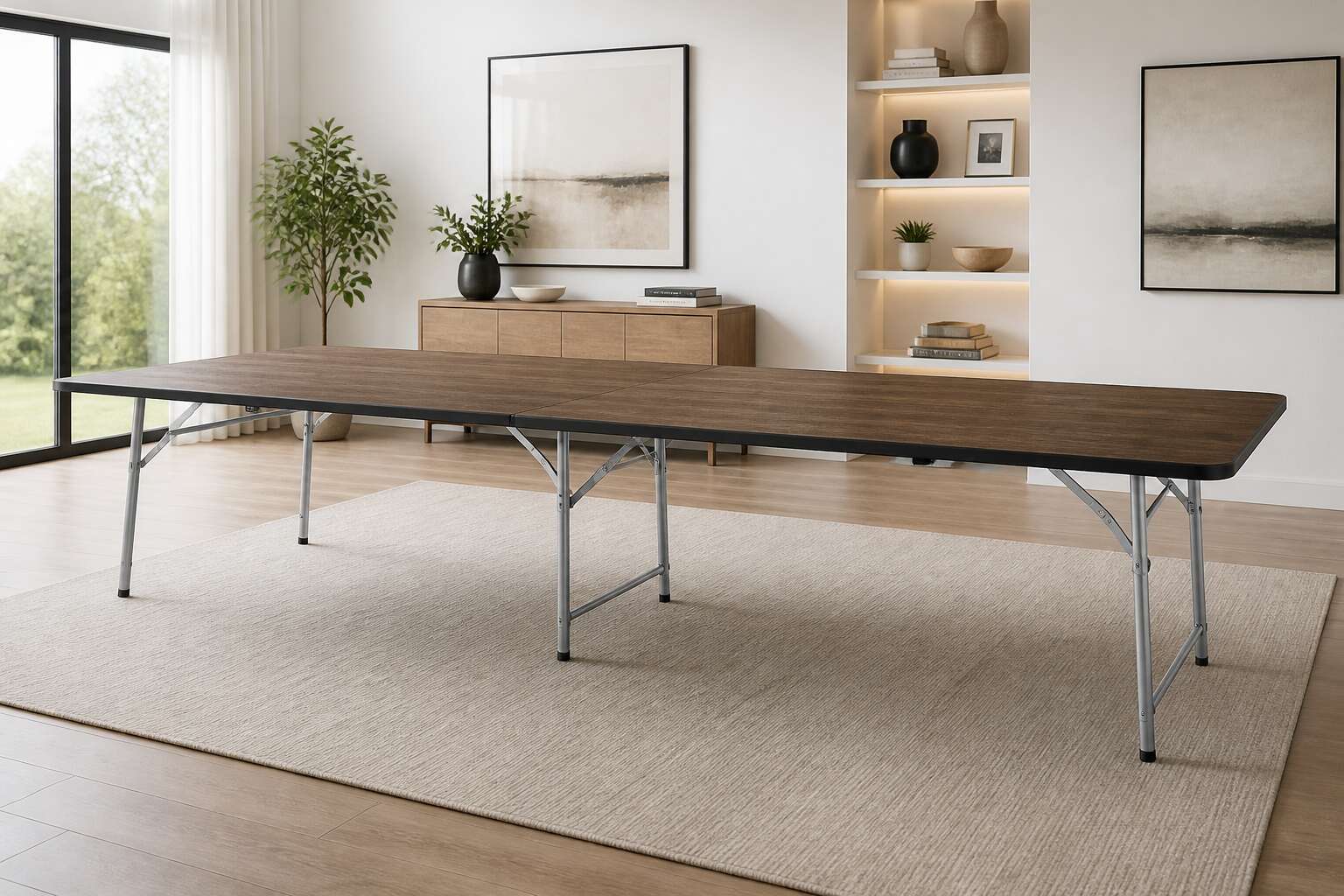
At a typical South African family gathering, seating chaos often steals the spotlight. A folding table xl changes that instantly. Before buying, assess your primary use cases. Are you hosting Christmas lunches, birthday braais, or Sunday get-togethers? Each event demands different surface space and durability.
Consider how many guests you typically host. A larger table suits extended families that overflow standard dining sets. It also handles buffet spreads, gift tables, or dessert displays. The XL size gives you room to arrange food and utensils without crowding.
Your venue matters too. Indoor celebrations require a table that fits through doorways. Outdoor events call for weather resistant surfaces. Measure your space first.
Common scenarios where a folding table xl earns its keep:
– Multiple course meals for twelve or more people
– Simultaneous serving and seating areas
– Craft or activity stations for kids during gatherings
Match the table to your busiest holiday. That ensures it serves you year after year.
Supporting catering and buffet setups
Buffet lines grow long when space runs out. Caterers know that crowded surfaces cause spills and slow service. A folding table xl provides the footprint to lay out every course with breathing room.
Organise by zone. Hot dishes stay apart from salads, while plates and cutlery occupy their own corner. That separation keeps guests moving and prevents pileups. For multiple stations, one long table beats several wobbly ones.
- Chafing dishes and warmers
- Platters and serving bowls
- Stacked plates and napkin stands
- Drink dispensers and glassware
A durable table absorbs the pressure of a busy buffet without complaint.
Enabling craft, hobby, and workshop projects
Every workshop project eventually faces the same bottleneck: flat surface area. When I started assembling large timber frames, my small bench turned every measurement into a balancing act. A folding table xl changes that equation. It gives you a stable, expansive platform for cutting, clamping, and dry fitting without sacrificing garage space when the job ends.
Hobby work rarely respects boundaries. Paint splatters, sawdust, and adhesive creep into every corner. Knowing your primary use cases helps you pick the right size. Model railway construction demands precision, while upholstery needs room to spread fabric.
- Cutting mats and rulers
- Power tool staging areas
- Drying racks for finished pieces
A folding table xl supports these tasks with a level surface that folds away between sessions, leaving your workspace open for other needs.
Accommodating professional and commercial needs
In South Africa’s bustling trade economy, every square metre of workspace counts. A folding table xl can turn a cramped storeroom into a functional depot for stocktaking, invoicing, or equipment prep. The real test comes when you lift, load, and move it daily.
Professional users need more than surface area. They need predictable stability on uneven ground, quick leg locks, and a wipe clean finish. I have seen vendors at roadside markets struggle with flimsy plastic tables. A folding table xl holds its own against wind, weight, and long hours.
- Mobile mechanics organising parts
- Photographers setting up lightboxes
- Electricians staging tools for site inspections
Assessing your primary use cases means measuring the table against these demands. When the table survives a week of fieldwork, you know it works for your trade.
Analyze Material and Construction Quality
High-density polyethylene versus laminate surfaces
Walk into any supplier and you will see rows of folding table xl options. The surface material separates the durable from the disposable. High-density polyethylene resists moisture and UV rays, which matters when your table sits in a Durban garden or a Johannesburg storeroom. Laminate looks pristine at first, yet it chips at the edges and delaminates as humidity seeps in.
I have tested both surfaces across seasons, and the difference is striking! HDPE feels denser in hand and resists chemical stains from cleaning agents. Laminate scratches easier and develops white marks under hot dishes. Consider the conditions your table will face:
- Coastal humidity that seeps into edges
- Sun exposure through unattended windows
- General stacking and shifting in storage
For a folding table xl expected to endure decades of abuse, HDPE outperforms laminate on nearly every measurable axis.
Steel frame gauge and reinforcement points
Lift any folding table xl and check the frame yourself. The steel gauge decides whether this unit survives a decade of Sunday meals or collapses into scrap metal by winter. I carry calipers when I inspect stock, because the gap between 0.8mm and 1.2mm steel is the gap between a professional surface and a temporary prop.
Turn the table over and study those reinforcement points! Weak frames use stamped brackets held by rivets, which work loose after the first few setups. Strong frames use welded gussets at every corner. The hinge brackets must be bolted through the full leg profile, not clipped onto its edge.
Look for these construction markers when you shop:
- Leg steel at least 1.0mm thick
- Cross-bracing under the tabletop
- Reinforcement plates at the lock mechanism
- A powder-coated finish that covers welds and seams
Impact of leg geometry on stability
The first thing I examine on a folding table xl is not the top surface but the geometry of its legs. A table can have thick steel and still wobble if the legs are poorly spaced. The distance between the feet determines the stability envelope. Narrow legs might fold into a smaller package, but they also turn a slight push into a tipping hazard.
Check the leg splay, the outward angle from the vertical. A splay of even five degrees widens the base meaningfully. The pivot point for the folding legs should sit near the bottom of the frame, lowering the center of gravity.
When you compare models, measure these three values:
- The footprint width from leg tip to leg tip.
- The vertical distance from floor to the main pivot bolt.
- The gap between the leg brackets when locked.
A folding table xl with a wider footprint and lower pivot will feel solid under a stack of plates or a sewing machine. The geometry is what makes a surface usable. Pay attention to it before you commit.
Corrosion resistance for indoor and outdoor use
Corrosion costs global industries billions each year, yet the humble folding table xl rarely gets credit for surviving the same elemental abuse. Salt air, sudden downpours, and relentless UV rays do not care about your brand loyalty. They will test every weld, every fastener, and every coating. Corrosion resistance is not an afterthought. It is the quiet line between a table that lasts a decade and one that leaves rust stains on your garage floor.
I look for galvanised steel or a powder coated finish that has been applied over a properly prepared surface. A cheap paint job will bubble, then peel, then expose the metal underneath. Aluminium frames offer a lighter alternative, but they still need treated fittings at the stress points. If you plan to move between a coastal braai and an indoor workshop, your folding table xl will endure temperature swings and moisture. Coastal humidity is aggressive. It finds the smallest scratch.
What separates a quality unit from one destined for the scrap heap? Check these three details:
- The attachment of the leg brackets to the frame. Are they welded or just riveted with soft metal?
- The underside of the tabletop. Is the core sealed against water ingress, or will a spill seep into the layers?
- The hardware coating itself. Zinc plated bolts resist oxidation far longer than bare steel screws.
That is the quiet brilliance of a well built unit. It offers no spectacle, no obtrusive design language. It simply refuses to decay. For anyone who has watched an inexpensive table disintegrate after one outdoor season, the extra investment feels less like a premium and more like a promise. The material is the character of the table. Trust it accordingly.
Edge profiles and safety considerations
Character alone will not save a bruised shin. A folding table xl proves itself through edge profiles and the safety details hidden in its mechanism. I run my hand along every rim before recommending a unit. A properly radiused edge, moulded rather than hastily routed, protects wrists and tablecloths through years of service.
Safety extends beyond the surface. Folding mechanisms create pinch points that demand shrouded hardware and firm latches. Loose clicks and exposed springs predict failure. Consider these checks:
- Are edge bands bonded or merely pressed into place?
- Does the frame include protective corner caps?
- Are locking mechanisms tool operated or finger friendly?
That last distinction matters in a busy hall. A folding table xl with exposed springs will eventually catch a sleeve or a finger. The mechanism should disappear into the frame, not demand attention.
Verify Dimensions and Weight Limits
Understanding width and length measurement variations
Before you trust the sticker, verify the dimensions of your folding table xl. Width and length measurements vary by brand. Some manufacturers measure the outer edge, others the inner leg span. This discrepancy matters for a room layout. For example:
- Edge measurement includes the rounded lip, adding 2 cm.
- Frame measurement stops at the metal support, subtracting 1 cm.
- Surface measurement ignores overhang, which differs by 3 cm.
Weight limits on a folding table xl also need scrutiny. A listed capacity assumes an even load. A heavy object on one corner changes the effective limit. The design might handle 200 kg, but only when distributed. A single crate of bricks on one end could tip the balance. Understand these variations before you commit.
Matching height to standard chair dimensions
An overlooked detail when choosing a folding table xl is how its height aligns with your chairs. Standard dining chairs seat you around 45 cm from the floor. A table top at 75 cm suits that comfortably. But many XL models sit higher, especially those with reinforced legs. Measure the gap between seat and table edge. Anything over 30 cm forces a slouch or a stretch.
Weight limits demand the same attention. A folding table xl rated for 200 kg handles that load only when spread evenly. I have seen a printer on one corner cause a wobble that a central placement never would. Consider these points:
- Check the height before buying, not after assembly.
- Test the table with your own chairs, since seat depths vary.
- Place heavy items over the leg supports, not between them.
That last habit extends the table’s life. A corner load can bend a frame that otherwise carries a full spread with ease. Matching height to your chairs and respecting load distribution turns a practical surface into a reliable one.
Evaluating load distribution across a wider surface
Most load ratings assume the weight sits perfectly even across the surface. A 2 metre folding table xl rated for 250 kg never sees that ideal in practice. A deep freeze on one corner, a stack of timber across the middle, these create point loads the frame never anticipated. The wider the table, the more leverage a concentrated weight gains over the leg spread. The rated capacity reflects an even distribution. The reinforcing struts under the deck matter more than the number in the brochure.
Two checks matter most. First, whether the rating applies to the whole surface or only the frame. Second, how the table behaves with a heavy object at different points. A folding table xl with wide spaced legs keeps the load within the footprint of those supports. Heavier items distributed across the full width hold the frame inside its rated envelope.
Prioritize Portability and Storage Features
Built-in carry handles and grip ergonomics
The true test of a folding table xl never happens during the meal. It happens when the last guest leaves, and the festive energy fades into the quiet chore of stowing it away in a narrow Cape Town garage or a small Jozi flat after a long Sunday braai.
Portability begins with the engineering of the carry point. A moulded, ergonomic grip should sit flush against the frame, ensuring your knuckles never graze the cold steel. This design shifts the centre of gravity towards your body, turning an awkward wrestle into a balanced walk.
Consider what makes a grip truly useful:
- Textured surfaces that stay firm under a sweaty palm.
- A recessed cut-out that doesn’t disrupt the flat profile of the table.
- Reinforced mounting points that won’t shear under stress.
Beyond the handle, the folded footprint dictates your storage options. A lockable leg system holds the frame flush, so this folding table xl leans against a wall without gouging the plaster. The less space it claims when collapsed, the more freedom you have in your cupboard or under the stairwell.
Folding latch security and one-person setup
Weak latches turn a folding table xl into a permanent wall ornament. The locking mechanism, not the surface, decides whether you actually use it next month. A proper latch releases both legs with one deliberate motion, letting a single person collapse the frame without contortion. If you need a second pair of hands or a well-aimed kick, the design has failed.
Storage is the hidden cost. A folding table xl that folds carelessly steals floor space in a cramped garage. The collapsed frame should sit flush, legs locked tight against the underside. Inspect these points:
- Spring-loaded pins that retract smoothly
- A secondary safety catch that prevents accidental release
- Feet that tuck inward to avoid snagging on carpet
In my experience, one person must manage the entire sequence. If the table resists, it stays in the corner.
Calculating storage space requirements
Storage space in a South African garage is measured in centimetres, not optimism. A folding table xl that claims to collapse but still leans awkwardly against the wall becomes a permanent obstacle. Measure your available space before purchase. The folded depth matters as much as the surface length.
Consider the carry path too. A table that folds flat in the garage still needs to travel through doorways and down passages. Check these numbers:
- Folded height against your wall
- Width through your narrowest doorway
- Weight when lifted alone
I once watched a buyer realise their folding table xl required a second person just to move it from the storeroom to the bakkie. The portability features looked fine on paper. They failed in practice. That single experience taught me more than any spec sheet!
Protective covers, straps, and transport carts
Portability remains the silent promise of a folding table xl. The moment a table gains a protective cover, it transforms from furniture into equipment. A canvas sleeve with reinforced stitching shields the surface during transit and keeps dust from settling into the hinges.
Transport carts deserve your attention. A trolley rated for the folded weight of a folding table xl saves your back on move days. Straps with ratchet buckles hold the table securely against the cart frame, even over uneven pavements.
A practical portability package includes:
- Wheeled carts with locking castors
- Padded shoulder straps for hands-free movement
- Weather-resistant covers for outdoor storage
Consider what happens between venues. The parking lot, the pavement, the lift lobby. These are the spaces where corners get scuffed and surfaces take damage. Quality portability gear anticipates these moments long before you exit the garage.
Review Purchase Factors and Longevity
Comparing price-per-square-foot across larger formats
Most buyers compare sticker prices without dividing by surface area. That oversight can cost you hundreds over the table’s life. For a folding table xl, the price per square foot often drops below that of smaller models, even when the upfront number looks higher.
I have seen a 1.8 metre unit priced at nearly double a standard 1.2 metre table, yet it offers more than twice the usable surface. That ratio changes the purchase decision. Add durability to the equation, and the long-term savings become even clearer. A robust large format table that survives years of heavy use outperforms a cheaper alternative that fails after a season.
Manufacturer reputation and part replacement availability
A table’s reputation travels ahead of it. I have seen folding table xl units fail within months, not because the top buckled, but because the manufacturer vanished when a hinge snapped. That is the hidden cost of an unknown brand.
Before you buy, ask who stands behind the unit. Reputable makers publish spare part catalogues, offering replacement feet, locking mechanisms, and leg caps. If a manufacturer cannot supply a simple part, they likely cannot guarantee structural integrity either.
Consider these checks when reviewing a brand:
- How long have they produced commercial grade furniture?
- Do they list part numbers for individual components?
- Are spares stocked locally in South Africa?
Longevity flows from accountability. A brand that tracks its parts tracks its quality.
Multi-table compatibility for expanded configurations
A solitary folding table xl serves well, yet the true test of longevity emerges when you pair several units for an expanded configuration. The seams between tables become the weakest points, so examine the frame geometry before committing. Not all large format tables share the same leg placement or height tolerance.
When linking multiple units, check three details:
- Whether the table edges sit flush without a gap
- If the locking mechanisms align across different production batches
- How the feet distribute weight when tables are placed in a row
These factors affect not only daily use but also the structural lifespan of every unit. A mismatched set forces one table to bear uneven loads, accelerating wear. Invest in units designed for continuous side by side use, and the expanded configuration will hold its integrity for years.
Cleaning routines and surface maintenance
A folding table xl often outlives its warranty, but only if the surface receives proper maintenance. The finish, not the frame, is where most tables fail. Review purchase factors like solvent tolerance and sealed edges. Some surfaces dull after a single bleach wipe, while others handle daily sanitation. Here are three surface details that matter:
- Resistance to abrasion from scrubbing pads
- Reaction to common disinfectants
- Ease of removing dried residue
Cleaning routines should align with these characteristics. A textured surface hides scratches but collects grime in tiny pores. A smooth surface wipes clean instantly yet shows every scuff. The correct approach involves mild soap, warm water, and complete drying before storage. Over time, a table retains its integrity if the routine matches the material.
Warranty coverage and return policies
Warranty terms reveal more about a folding table xl than the spec sheet ever will. A manufacturer that offers a five year frame warranty expects the steel to survive serious punishment. But check what the warranty actually covers. Surface delamination, rust formation, and hinge failure are the usual culprits, yet many policies exclude exactly those components.
Before you buy a folding table xl, ask these questions:
– Does the warranty cover surface wear or only structural failure?
– Who pays for return shipping on a defective unit?
– Is there a restocking fee for wrong size orders?
Return policies matter equally. Some suppliers require the original packaging, which most buyers discard within a week. Others offer a 30 day trial period with free collection. A generous return window signals confidence in the product. A restrictive one suggests the seller knows something about failure rates.
Reading spec sheets versus handling products in person
A spec sheet tells you the intended capacity, not the actual build quality. To judge a folding table xl, you must get your hands on it. Feel for weld spatter along the joints. Smooth, consistent welds indicate controlled manufacturing. Then, grip the tabletop and twist gently. A little give is normal, but excessive torsion reveals weak cross-bracing. Also, inspect the rivets and fasteners. Loose hardware now means squeaking and failure later. Here are three quick checks:
- Place the table on an uneven surface and watch for rocking.
- Open and close the mechanism twenty times to feel for binding.
- Examine the underside for skip welds or missing sealant.
Each of these factors influences how many years you get from your investment. A cheap unit might pass every spec test yet fail within twelve months.


0 Comments