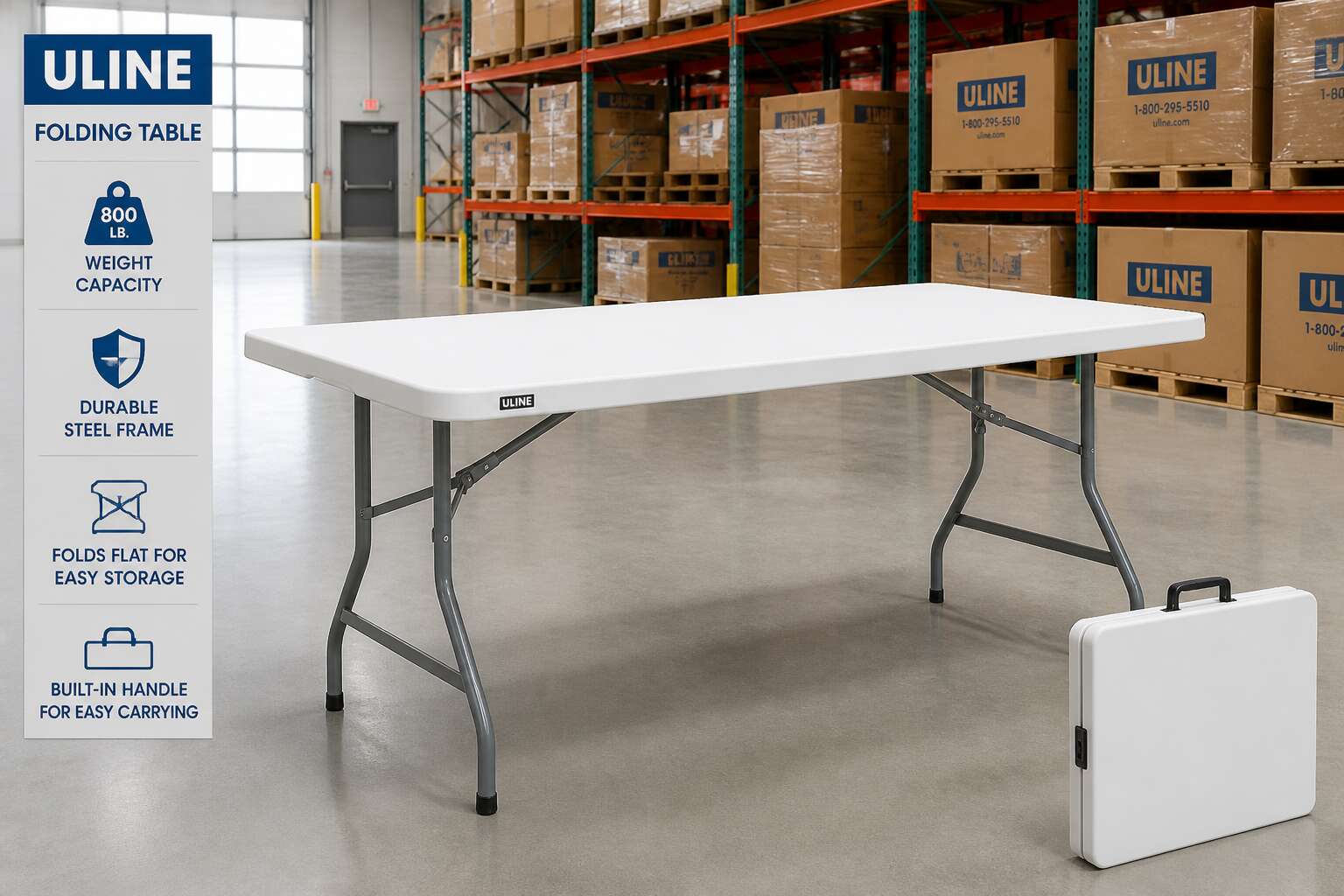
Why Choose Uline for Portable Seating and Workspaces
Built-in Durability for Heavy-Duty Use
Portable seating often fails where it matters most: under pressure. Yet Uline’s folding table uline range handles daily abuse on construction sites, warehouses, and exhibition floors across South Africa. The frames use reinforced steel crossbars and welded joints, so they withstand repeated assembly and heavy loads. I have seen cheaper tables bow after one season; Uline’s tables keep their geometry!
In heavy-duty use, a folding table uline offers tangible benefits:
- Rip resistant table tops that resist cuts and solvent spills.
- Leg locks that stay engaged without constant readjustment.
- Rubber feet that grip polished concrete and uneven terrain.
These details matter when you set up a temporary workbench. The built in durability extends to the hinges, often the first failure point in cheaper designs. Uline tests these units beyond standard retail expectations, explaining their presence in logistics yards and municipal workshops.
Lightweight Designs for Easy Transport
Trade show floors in Johannesburg turn into a battlefield of awkward logistics by midday. I have watched event staff wrestle with wobbly tables that refuse to lock, while exhibitors balance laptops on uneven surfaces. That scene explains why so many South African businesses have switched to the folding table uline for their portable seating and workspaces. The difference is not subtle. A Uline table becomes a stable platform the moment you unfold it, and that reliability changes how people work.
The ergonomics matter more than most buyers expect. A folding table uline places the work surface at a height that suits standing tasks, which reduces back strain during long setup hours. The leg geometry provides clearance for chairs, so people can sit without knocking their knees against crossbars. That simple design consideration makes these tables useful for training rooms, pop-up offices, and outdoor events where comfort is often an afterthought.
– The locking mechanism engages with a single motion, so setup takes seconds.
– The tabletop surface offers enough friction to keep papers and tools from sliding.
– The frame width accommodates wheelchairs and office chairs without modification.
These features turn a basic utility item into a workspace solution. I have seen catering teams use them as prep stations, technicians use them as testing benches, and registration desks use them as check-in points. The versatility comes from the design, not from accessories.
Lightweight designs for easy transport make the folding table uline a practical choice for mobile operations. The aluminium frames keep the total weight manageable, so one person can carry a table across a parking lot or up a flight of stairs. The folded profile fits into a bakkie or a small trailer without wasting space. For businesses that move between venues, this portability reduces labour costs and speeds up breakdown.
The carrying handle sits at the balance point, which sounds minor until you carry ten tables in an afternoon. The folded unit locks shut, so nothing swings loose during transit. The compact shape also stores neatly against a wall, which matters for workshops and storerooms where floor space is scarce. A folding table uline does not demand a dedicated storage area, and that convenience adds up over years of use.
Cost-Effective Solutions for Bulk Purchasing
The arithmetic of procurement changes when you need workstations for an entire fleet, not a single boardroom. A bulk folding table uline order drops the unit price until temporary infrastructure becomes cheaper than permanent installations. Johannesburg businesses run multiple venues, and each site tolerates zero inconsistency. Buying fifty tables at once standardises the locking mechanism, the parts bin, and the way staff set up.
Bulk purchasing also compresses freight costs. One pallet delivery to a warehouse in Midrand replaces a stream of separate consignments. The initial outlay falls, and the table’s practical lifespan spreads that expense across a few hundred shows.
The block purchase makes Uline the low-cost supplier for portable seating and workspaces:
- One folding table uline model fits every usage, from catering prep to registration booths.
- Bulk delivery shrinks freight expenses per table.
- One parts supply covers every damaged hinge and leg.
That level of price control matters when you are making decisions for next year’s event season.
Available Styles and Configurations
Banquet Tables for Events and Gatherings
At a bustling fundraiser, the difference between a round table and a serpentine layout is the difference between conversation and silence. The folding table uline catalogue offers a spectrum of shapes, from 60 inch rounds to six foot rectangles, each with its own social dynamics.
Half rounds tuck against walls to open floor space. Banquet rounds seat eight with room for service. Narrow rectangular tables suit buffet lines or work sessions.
- Serpentine curves guide guests through a serving area
- Chevron shapes focus attention forward during presentations
- Classroom rows pair with folding chairs for training events
Each shape changes sightlines and traffic. Selecting from this range requires examining the venue and the guest list.
Utility Tables for Industrial and Warehouse Settings
Utility tables in industrial settings handle more than paperwork. A warehouse workbench faces heavy tools, spills, and constant movement. Choosing the right configuration goes beyond the basic rectangle. Consider adjustable heights to accommodate standing inventory checks and seated assembly tasks.
Common configurations include:
- Folding leg tables with locking casters for quick repositioning
- Straight or lipped table tops to prevent parts rolling off
- Tiered shelving units attached for temporary storage
These styles allow a single folding table uline to double as a packing station or a crew breakout space.
For packaging, a smooth laminate top beats a rough surface. For metalwork, a steel top resists dents. Scrutinise the frame geometry when choosing a unit. A robust X-frame offers greater stability than a scissor hinge. An industrial environment also needs flat-folding designs, freeing valuable floor space for forklifts. For instance, a maintenance bay might require a table that locks into place.
Adjustable-Height Options for Ergonomic Needs
Available styles vary more than most buyers expect. A folding table uline arrives in rectangular, round, and half-round shapes. Some models offer a fixed height, while others adjust through a simple crank or spring mechanism. The half-round style fits against walls, creating a temporary desk for site offices in Johannesburg or Cape Town.
Adjustable height options serve ergonomic needs directly. A person standing to sort components needs a surface at elbow level. A person seated needs a lower plane. One table can shift between these positions throughout a shift.
Common adjustable configurations include:
- Crank-operated models for smooth vertical movement
- Pneumatic lift tables for incremental changes
- Push-button locking legs with preset stops
These variations let a single unit serve different tasks without repeated purchases. For any workspace facing mixed tasks, an adjustable folding table from Uline removes uncertainty from daily setup.
Compact Folding Designs for Space-Constrained Areas
Compact folding designs solve the common problem of too much furniture for too little floor space. In South African flats and home offices, a folding table uline offers configurations that collapse to mere centimetres in depth. Rectangular models fold in half, while round versions split into two hinged leaves. For tight corners, half-round tables press flat against the wall, creating an instant workspace that disappears when not needed.
The most practical setups include:
1. Flip-top tables that mount to a wall bracket and drop down only when required.
2. Trolley-style folding table uline units with wheels, sliding easily into a pantry or storage closet.
3. Stackable trapezoid tables that interlock, reducing their combined footprint by two-thirds.
Each style balances portability with stability, ensuring that even the smallest room can host a productive work session or a casual meal without permanent clutter.
Material and Construction Insights
High-Density Plastic vs. Laminated Wood Tops
A table’s top bears the brunt of every spill. In warehouses, that means hot pans, chemical splashes, and dragging tools. High-density plastic is hydrophobic and chemically inert. It repels moisture and resists fungal growth. Laminated wood offers a smoother feel but its composite core swells when water creeps past the veneer. Plastic retains its shape while wood laminates bubble at the edges.
Practical distinctions:
- Plastic cleans with one wipe.
- Wood laminate requires blotting and resealing.
- Plastic survives drops; wood chips.
For a folding table uline, the choice affects structural integrity. Plastic tops flex under load without cracking. Wood tops transfer stress to the frame, leading to premature looseness. For worksite orders, replacement cost favors plastic. In my years of facility audits, plastic tops have never delaminated. A folding table uline with laminated wood suits low traffic meeting rooms, where aesthetics trump endurance!
Reinforced Steel Frames for Long-Term Stability
The frame is the backbone of any folding table. Reinforced steel construction keeps the table rigid through years of heavy use. A properly engineered steel frame resists twisting, sagging, and lateral stress. That stability matters when the table supports heavy equipment or people leaning on its edges.
Look for specific design elements that add long-term strength. Thick-gauge steel tubing forms the base, while reinforced cross-bracing at the legs prevents wobble. Welded joints are far stronger than bolted connections, which loosen over time. These details ensure the table holds its shape after hundreds of setups and breakdowns.
For a folding table uline, this kind of steel frame means you can depend on it during busy events or in demanding work environments. A stable base also protects the tabletop from uneven stress, extending the entire unit’s lifespan. When comparing options, check the frame’s gauge and bracing pattern. Those indicators separate a lasting investment from a short-term fix.
Surface Treatments for Scratch and Stain Resistance
A single coffee spill can etch itself into an untreated surface forever. Surface treatments block that damage before it starts. For a folding table uline, the finish determines how well the table endures years of heavy use. A quality coating separates a reliable workhorse from a liability.
Modern coatings create a dense barrier that repels oils, acids, and cleaning chemicals. This layer also absorbs minor impacts without cracking or peeling. The result is a tabletop that stays presentable even after countless setups, breakdowns, and storage periods.
- UV stabilized layers prevent fading under harsh light
- Textured finishes disguise light scratches and scuffs
- Sealed edges stop moisture from seeping into the core
Impact of Frame Hinges and Locking Mechanisms on Safety
When a folding table collapses mid-use, the consequences range from spilled drinks to serious injury. The hinge design and locking mechanism are the quiet guardians that prevent these scenarios, yet they rarely get the attention they deserve. On a folding table uline model, the hinges must handle thousands of open and close cycles without developing play or wobble. Loose hinges create instability, and instability leads to accidents.
The locking mechanism matters just as much as the hinge itself. You want a system that engages positively and audibly, giving you clear confirmation that the table is secure before you load it with anything heavy. Push-button releases offer convenience, but they should never be so loose that they trigger accidentally. The best designs use a spring-loaded pin that seats firmly into a machined receiver, eliminating any chance of sudden folding.
Consider these safety-critical features when evaluating frame quality:
- Reinforced hinge brackets with multiple rivet points rather than single spot welds
- Locking levers that require intentional pressure to disengage
- Rubber or nylon bushings at pivot points to prevent metal-on-metal wear
- Corner braces that transfer load directly to the legs instead of relying on the hinge alone
Any of these failing components turns a dependable work surface into a hazard. In busy South African venues, from school halls to exhibition centres, tables endure constant folding and unfolding. That repeated stress fatigues weak designs quickly. A folding table uline with properly engineered hinges and locks will survive years of that punishment while keeping users safe. Safety is not a passive feature; it is engineered into every moving part.
Practical Applications Across Industries
Event Planning and Hospitality Venues
Event planners across South Africa juggle dozens of venue layouts each week. The folding table uline lists in its catalogue converts a narrow boardroom into a spacious U-shape configuration in under five minutes. That speed matters when a client books the same hall for a morning workshop and an afternoon reception.
Hospitality venues benefit from the same adaptability. Hotel staff in Johannesburg and Cape Town routinely shift banquet rooms between buffet service, seminar seating, and cocktail formats. When not in use, the tables collapse onto trolleys and free up floor space for dance floors or product displays.
- Set up registration desks along a hallway without blocking fire exits
- Create temporary bar stations at outdoor functions
- Arrange tiered gift or auction tables near the entrance
- Support catering equipment during peak dinner service
Venue managers who already own a folding table uline delivers report smoother transitions between events, fewer staff hours spent on manual lifting, and a cleaner overall aesthetic. The real gain is that spaces adapt to the event instead of forcing the event to fit the room.
Warehouse and Shipping Operations
Warehouse managers measure productivity in minutes lost, not hours saved. A packing station that takes too long to set up costs more than time; it costs the rhythm of the entire shift. In a Johannesburg distribution centre, the folding table uline offers a simple answer to a daily problem. Staff can wheel a unit from a storage rack to the dispatch bay, lock the legs, and start processing orders. No tools. No lengthy assembly.
Shipping operations face constant pressure to adapt. One day the floor holds a large consignment of palletised goods. The next day, the same space must accommodate a small team doing spot checks on returns. The folding table uline handles this shift with ease, which is why many logistics managers keep several units in reserve. They are not a permanent fixture. They become a temporary work surface for labelling, a counting area for stocktaking, or a station for sealing parcels before the courier arrives.
- Create a temporary inspection bench for inbound deliveries
- Set up a quick sorting zone for mixed stock returns
- Establish a separate area for fragile item packing
- Use as a mobile desk for handheld scanner charging and data entry
Some operations keep the tables in a dedicated staging bay. Others store them upright against a wall and pull them out during peak seasons. The flexibility matters in an environment where floor space is a premium asset. A manager in Durban recently told us that his team uses the units to separate urgent orders from the general flow. That simple action reduced misrouted parcels by a noticeable margin.
The real value appears during stocktaking. Auditors need clear, stable surfaces to lay out inventory lists and scan items. A folding table uline placed between the shelving rows gives them room to work without blocking the aisle completely. Once the count finishes, the table folds flat and slides back into its corner. The warehouse returns to its natural traffic pattern. That is the point of furniture that understands the working day. It supports the task, then disappears until the next demand.
Catering and Food Service Environments
Catering runs on logistics and nerve. A banquet manager’s worst nightmare is a chafing dish with nowhere to rest. That is where the folding table uline earns its keep. These units pop up between courses, hold trays of grilled fish, and vanish after the last plate is cleared. One Johannesburg caterer keeps six in the van for pop-up events. They are not for guests to see. They are for the crew to survive.
- Set up a hydration station for staff
- Build a clean zone for garnishing
- Keep a spare surface for the coffee urn
- Create an emergency pastry station
The folding table uline also helps during venue inspections. Health inspectors want clear counters and separate zones. A table can temporarily divide raw preparation from finished platters, then fold flat before the venue manager starts fretting about floor space. In a hot kitchen, that flexibility is worth more than a permanent fixture. It is a table that understands service. It appears, supports, and disappears without demanding attention.
Corporate Training Rooms and Conferences
Corporate training rooms and conferences demand flexibility. A folding table uline transforms a static boardroom into an adaptable learning space. Quick reconfigurations allow for u-shaped layouts, clusters for group work, or rows for presentations.
During breakout sessions, these tables support laptops, notebooks, and refreshments. Their lightweight design lets facilitators rearrange spaces between modules without disrupting momentum. For multi-day events, storage is simple; fold and roll them away each evening.
- Create a half-day workshop setup with six tables in a horseshoe.
- Convert to theater style for keynote speeches in under ten minutes.
- Use side tables for registration or material distribution.
The durability of a folding table uline handles heavy binders and repeated handling. It is a practical investment for any corporate venue aiming to maximize every square meter.
Maintenance and Longevity
Cleaning and Sanitizing Best Practices
Most people overlook the hinge area when sanitizing a folding table uline, but that’s where the real grime hides! After a busy event, food particles and spilled liquids work their way into the joints, accelerating wear on the locking mechanism.
Start with a dry microfiber cloth to remove loose debris. Then mix a mild detergent with warm water, applying it with a soft sponge. Avoid abrasive pads, as they can dull the protective surface treatment. For stubborn stains, a solution of vinegar and water works well, but rinse thoroughly to prevent residue buildup.
- Wipe down the tabletop first, then the legs and hinges.
- Pay extra attention to the fold points where dirt accumulates.
- Dry the entire unit completely before storing it.
Sanitizing regularly extends the lifespan of the frame and keeps the table presentable for every use.
Proper Storage Techniques to Prevent Damage
A folding table uline endures years of abuse, yet the storage room can ruin it. I have watched frames warp because someone stacked crates on top! The correct approach involves vertical storage in a climate controlled space. Moisture rusts hinges, so dry air is essential.
Debris trapped in the joints causes locking mechanisms to seize. The physical arrangement matters as much:
- Surfaces wiped clean and dry
- Legs locked securely
- Unit leaned against a wall, not flat on the floor
That configuration prevents structural distortion and keeps the table ready for the next event.
Replacing Worn Parts and Extending Product Life
Most folding table failures do not start with a dramatic collapse. They begin with a hinge that feels loose, or a leg that catches when you unfold it. We ignore these signs, and then the table lets us down at the worst possible moment. The real issue is that we treat the whole unit as one object, when it is actually a system of independent parts. Each of those parts has its own lifespan.
After years of service, the locking pins and hinges on a folding table uline will eventually wear. The frame might stay straight, but the joints will start to develop play. You can often fix this without buying a new table. A few simple replacements can restore the stability that you relied on when the unit was new. A little attention here saves you from a full replacement later.
Common points of failure to inspect:
– Hinge bolts that have worked themselves loose
– Plastic caps that have cracked on the leg ends
– Locking levers that no longer catch cleanly
When you find a loose bolt, tighten it. When you find a damaged cap, replace it. These are cheap fixes. The tabletop itself will also show signs of aging. Laminated surfaces can peel at the edges after repeated impacts. In that case, you need to decide whether the damage is cosmetic or structural. A chipped edge is an eyesore, but a delaminating core compromises the entire surface. If the core has started to swell from moisture, no cleaning will fix it.
A folding table uline can serve you for decades, but only if you treat the moving parts as consumable items. The frame is the soul of the table, yet the hinges and fasteners are the muscles. Once you accept that these smaller elements will need attention, you can extend the useful life of the whole assembly far beyond what a casual user might expect. Do not wait for the leg to buckle under a loaded platter. Address the play in the joint the moment you feel it. That simple act of diligence keeps the table functional and safe for years to come.


0 Comments