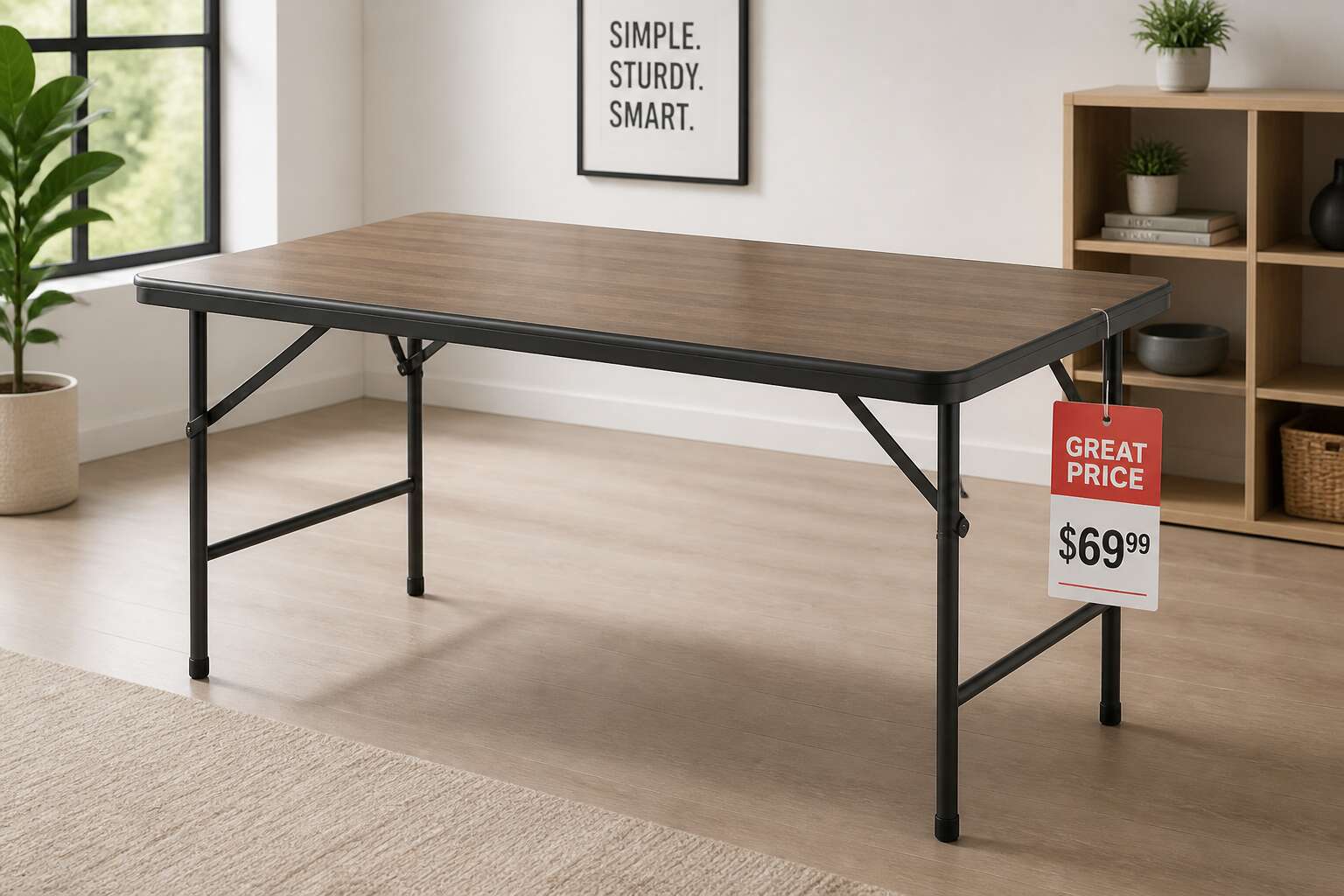
Key Factors That Shape What You Pay
Material Quality and Durability
A poorly constructed folding table often feels robust under the palm, yet betrays its weakness within a season of use. The true measure of value lies not in the initial handshake, but in the quiet groan of stressed joints after a year of service. The material grade dictates the lifespan, and therefore, the folding table fair price must be validated against the raw components, not just the aesthetic veneer.
Hollow cores and thin steel skins create a deceptive lightness. Manufacturers rely on this to cut shipping costs, but you inherit the burden of premature failure. Conversely, high-density polyethylene (HDPE) tops resist staining and cracking, while a 1.2mm thick steel frame offers structural rigidity that absorbs the shocks of daily handling. Ask about the plastisol foam or the powder coating process; these layers are the protective armor against rust and scratches in humid coastal climates.
A cheap table is often rebranded and sold at a premium by clever marketers. The buyer must become a forensic examiner of the spec sheet.
– Look for the leg geometry; a wider stance prevents racking and sway.
– Examine the pivot points. Are they riveted or bolted? Bolted hardware allows for replacement.
– Check the weight capacity rating against your actual load, not a theoretical maximum.
The slumping melamine top and the bent hinge are the telltale signs of a deceptive bargain. A fair price is simply the point where the raw material cost, the manufacturing tolerances, and the expected service life converge without fantasy. That is the only arithmetic that matters.
Size, Weight Capacity, and Portability
Size dictates both utility and freight costs. A 6-foot table suits a banquet hall, while a 4-foot model serves a pop-up stall. The folding table fair price jumps when dimensions push beyond standard moulds, because non-standard tooling raises production expenses. Weight capacity follows a similar logic. A table rated for 300 kilograms costs more than one rated for 100, simply because the frame needs thicker steel and more cross-bracing.
Portability changes the equation. Folding mechanisms with locking latches add convenience but also add production complexity. Consider these factors:
- Overall footprint when folded.
- Handle placement and ergonomics.
- Wheel quality if the table includes casters.
Each element shifts the price. The folding table fair price is ultimately a balance between physical footprint, load tolerance, and the effort required to move the table. A lighter table with a high capacity will always command a premium, and the buyer must weigh which trade-off matters most for their specific venue.
Brand Reputation vs. Off-Brand Alternatives
A trusted brand is essentially a ledger of failures that never happened. That history carries a price, and the folding table fair price includes it. Off-brand alternatives can look identical in product photos, yet they often differ in steel gauge, weld continuity, and the quality control that catches defects before shipment.
The premium paid to a known manufacturer typically covers:
- Documented load testing and compliance with South African safety standards
- A functional warranty process that does not require months of follow-up emails
- Availability of spare parts such as hinges and locking brackets long after the sale
None of that appears on a spec sheet. It surfaces only when something fails. A buyer who chooses the cheapest option might save R300 at purchase, then lose that amount and more when a leg buckles during a high-profile function. A folding table fair price is less about the sticker and more about how the product behaves in year three.
Retail Markup Versus Wholesale Pricing
Wholesale pricing is the manufacturer’s asking price. Retail markup is what keeps the lights on. That gap, often 30% to 50%, pays for showroom space, staff salaries, and the willingness to accept returns. The folding table fair price sits somewhere between what a supplier charges and what a shop must earn to stay open. A dealer who sells below cost is either clearing stock or cutting corners.
Different retail environments treat that markup differently. A large hardware chain spreads its overhead across massive volume. A small rental supplier has to cover the cost of delivery, repair, and the occasional lost table. Both answers can be fair, but they diverge.
Added Features That Justify a Higher Price
Market timing shapes the folding table fair price more than most shoppers assume. August demand from schools and churches drives prices upward, while January surplus forces discounts. Regional logistics also matter; a table manufactured in Gauteng costs less to deliver than one shipped from Durban, and that difference shows up in the quote.
Added features that justify a higher price include:
- Quick release locking legs that fold flat in one motion
- Chemical resistant surfaces that survive solvent spills
- Reinforced perimeter skirts that resist racking under heavy loads
A dealer who stocks tables with these details carries less liability and fewer returns. That assurance carries a premium, and my own experience suggests buyers pay it willingly when they compare long term use against repeated repair costs. The fair price reflects timing, logistics, and practical engineering; the sticker on the crate merely sets the baseline.
Typical Price Ranges Across Common Table Types
Plastic and Resin Folding Tables for Everyday Use
In South Africa, plastic folding tables for everyday use slot into three distinct price bands. Each band reflects market demand, production costs, and retail expectations, but not necessarily quality.
- Basic utility models: R250 to R500.
- Sturdier resin blends: R550 to R850.
- High end resin tables: R900 to R1300.
These ranges are not fixed. Local stock shortages push prices upward, while year end clearance drops them. The folding table fair price, then, becomes a moving target. I have found that paying a third above the midpoint means you are funding something other than the table itself. For a resin table used weekly, plan around R750.
Wooden and Laminate Banquet-Style Options
For wooden and laminate banquet-style folding tables, the price spread tells a different story. A basic laminate table with a particle board core runs from R1,200 to R1,800. A solid wood version, often with a hardwood frame, moves from R2,000 to R3,500. These are heavier units, designed for events rather than everyday use. The folding table fair price for this category depends on what you need to support.
- R1,200 to R1,500: thin laminate, lighter duty
- R1,600 to R2,000: thicker top, reinforced legs
- R2,000 plus: solid wood, banquet grade
Transport costs and finish quality shift these numbers. I usually tell people to avoid paying over R2,500 for a laminate table unless it comes with a warranty. The wood options, though pricier, hold up better against repeated setup and takedown. Shop around, because the same table can vary by a few hundred rand between suppliers.
Lightweight Aluminum Models for Frequent Travel
Lightweight aluminum models are the road warriors of the folding table world. They typically sell from R800 to R1,500, with the spread dictated by frame gauge and surface coating. A thin sheet will flex in a stiff breeze, while a reinforced top holds square. Consider what you are actually carrying:
- Basic utility aluminum: R700 to R950
- Mid range with carry strap: R950 to R1,200
- Pro grade with locking legs and reinforced corners: R1,200 to R1,500
The folding table fair price for aluminum hinges on how many bakkie trips it will survive. Frequent travelers should look for riveted joints and thicker alloy. Those features push the price up, but they also prevent a wobbly disaster at your next market stall.
Heavy-Duty Work Tables for Job Sites and Trades
Heavy-duty work tables for job sites and trades are a different breed. These are the tables that take punishment from grinders, clamps, and tossed toolbags. Prices range from R1,200 for a basic steel frame with a MDF top, up to R3,500 for a foldable unit with a phenolic surface and locking castors. The spread depends on leg gauge, hinge quality, and whether the top resists moisture and solvents. I have seen cheap tables buckle under a single sheet of drywall. A true job site table uses 1.2mm steel and cross-bracing.
Typical price points break down like this:
- Standard folding work table: R1,200 to R1,800
- Reinforced with adjustable feet: R1,800 to R2,500
- Pro grade with quick-release legs and scratch-resistant top: R2,500 to R3,500
When you compare options, remember that a folding table fair price is about longevity. Paying R1,500 for a table that lasts five years beats R800 for one that folds in two. For tradespeople, the table is a workbench, not a banquet table, so focus on joint strength and surface density.
Children’s and Utility Table Sizes at Lower Tiers
A children’s folding table or a small utility unit for the garage often sits at the entry level of the market. These are the models you see stacked in hardware stores, promising convenience for R250 to R600. The frames are lighter, with thinner steel that suits a child’s tea party, not a construction site. You get a basic melamine top and plastic corner caps that protect little fingers.
At this tier, the conversation around folding table fair price shifts drastically. You are not buying longevity; you are buying temporary function.
– Utility tables (1.2m x 0.6m): R300 to R550
– Children’s activity tables (0.6m x 0.6m): R250 to R450
– Compact indoor craft tables (1.0m): R350 to R500
The distinction matters. These tables often use 0.5mm steel and plastic hinges, elements that fail within two years of regular use. For a child’s bedroom, that lifespan is acceptable. For a monthly flea market stall, it is a trap. The fair price here is the lowest one, because you are paying for disposability, not durability. Owners rarely repair these; they simply replace them when the legs wobble or the top warps. That is the hidden cost of buying at the bottom tier, one that tradesmen understand but casual shoppers often miss.
Specialty Shapes and Adjustable Height Configurations
Beyond those entry level models, the typical price ranges show distinct patterns. A standard rectangular banquet table, 1.8 metres long, settles between R800 and R1,400. Round tables, often reserved for events, command a premium because their folding mechanisms require more engineering.
Specialty shapes and adjustable height configurations change the folding table fair price even further. A half-round table, a serpentine shape, or a model that shifts from coffee table to standing desk, each introduces costs that go beyond surface area.
- Half-round tables (0.9m diameter): R700 to R1,100
- Adjustable height tables (0.7m to 1.1m): R1,200 to R2,000
- Serpentine or boat-shaped tables: R900 to R1,500
These tables use more complex locking mechanisms and additional struts. I find the fair price reflects the extra hardware, not only the size. For someone who needs versatility, spending more on an adjustable model often replaces the need for two separate tables.
Hidden Expenses Beyond the Sticker Price
Shipping Fees and Delivery Surcharges on Oversized Items
The sticker price on a folding table is an invitation, not a promise. In South Africa, the distance between a warehouse and your door creates costs that rarely appear in the initial quote. I have watched buyers calculate a budget from a glossy online listing, only to discover that freight and handling fees add a significant margin to the final invoice. Shipping costs vary by province, and oversized items trigger special tariffs. These extras often include:
- A base delivery fee tied to package weight and dimensions.
- A surcharge for residential or rural addresses.
- An additional charge for curbside drop-off or liftgate service.
When you account for these, the difference between a cheap table and a decent one narrows dramatically. That is why a folding table fair price must include the full cost of acquisition, not just the amount printed on the tag.
Storage Demands and Protective Cases
Storage demands rarely enter the conversation when you compare folding table fair price. Yet the space a table consumes between events is a recurring cost. A stack of banquet tables requires a dry, secure room. That room has value, especially in South African homes where square meters are precious.
Protective cases add another layer. Canvas covers and padded bags shield edges from dents and scratches. Without them, repairs shorten a table’s life. A damaged table forces an earlier replacement, and that expense belongs in your assessment.
- Rent a storage unit monthly.
- Allocate garage space instead.
- Factor in the cost of covers.
These quiet expenses affect the folding table fair price, turning a simple number into a ledger of ownership.
Accessories That Add Up: Skirts, Clamps, and Carts
Accessories quietly reshape what a folding table fair price means. A banquet skirt turns an ordinary surface into a presentable display, but matching sets for a wedding or conference cost real money. I have seen buyers add four skirts and forget the clips entirely.
Clamps hold tablecloths down against wind and movement. They seem minor until one vanishes mid-event! Carts for moving tables are another line item. A sturdy cart saves your back, yet it can add a third to your total outlay.
- Skirt clips and magnetic fasteners.
- Corner guards for repeated setup and breakdown.
- Straps for securing stacked tables in transit.
Each accessory nudges the folding table fair price upward. Factor them into your budget before you accept a quote. That is the honest number.
Replacement Legs, Hinges, and Surface Repairs
Most buyers only look at the tag. They never consider what happens when a leg buckles or a hinge pin snaps. That is where the folding table fair price gets interesting. A replacement leg from a lesser brand can cost a third of the original purchase. Hinges wear out faster than you expect, especially on tables folded and unfolded weekly in busy venues.
Surface repairs are the real surprise. A laminate top chips along the edge, and suddenly you are looking at refinishing costs that exceed the table’s value. I have seen event venues discard entire tables over one cracked surface. The spare parts market is thin for cheap imports.
Common repair costs that catch owners off guard:
– Replacement legs for specific models
– Hinge pin kits and spring assemblies
– Laminate repair compound and edge banding
The real question is not what the table costs today, but what it costs over five years of service. That is the true folding table fair price.
Warranty Lengths and After-Sales Support
A two year warranty sounds generous until you read the fine print. In South Africa, many importers exclude commercial use from coverage, meaning your event venue’s tables are never protected. The true folding table fair price must include what happens when you need actual support.
Consider the claim process, and I have seen this firsthand. Some suppliers demand you return the table to a single service centre in another province. Shipping costs land on you. Load shedding also plays a role, as replacement parts wait in backlogged customs.
Warranty lengths vary wildly:
- Budget options: 3 to 6 months
- Mid range: 1 to 2 years
- Premium brands: 5 years or more
After-sales support separates the real folding table fair price from the sticker illusion.
Smart Shopping Strategies for the Best Value
Timing Purchases Around Seasonal Promotions and Clearances
South African retailers discount folding tables by roughly 30% in the weeks after New Year’s Day. December demand, powered by braais, weddings, and church gatherings, holds prices firm. Once that rush drains, stock lingers and stores must clear it, which gives patient buyers a folding table fair price.
Black Friday triggers the same urgency. The impulse to buy when everyone else buys keeps prices inflated, yet folding table markdowns rarely go beyond 10% during that event. Real value surfaces in quieter periods:
- Late January to mid February, when post festive clearances appear
- August, when wedding season slows and event rentals taper
- Midweek mornings, when store traffic drops and negotiated prices improve
In my experience, waiting two weeks past the holiday spike saves more than any discount voucher. A folding table fair price belongs to the shopper who watches the cycle, not the advertising.
Weighing Online Retailers Against Local Showrooms
Online retailers list lower prices, but local showrooms let you feel the frame and test the hinges. That physical check prevents costly errors. I have watched shoppers chase a screen price, then pay more in delivery. The smart strategy is to inspect in person, then compare the exact model online. If the online total, including shipping, undercuts the showroom price by more than 10%, the savings matter. Otherwise, the showroom price stands as a folding table fair price.
Three habits keep this comparison honest:
- Bring the online quote to the counter and ask for a match.
- Check the return policy before you buy.
- Test the fold action twice.
Negotiating at Warehouse and Outlet Locations
Warehouse outlets often list folding tables at low prices, but the sticker is only a starting point. At a Pretoria depot, I watched a shopper negotiate a floor model discount of R80 by asking. Staff at these locations have authority to adjust prices within limits.
Ask about scratch-and-dent units or discontinued finishes. Offer to buy multiple tables at once. Mention a competitor’s price and see if they match it. One manager told me haggling is normal, not rude. If you inspect the frame and fold action first, you can negotiate with confidence. That effort leads to a folding table fair price.
Follow these two habits:
- Request a written quote before you commit.
- Confirm the return policy covers outlet purchases.
Then you can shake hands knowing you paid well!
Evaluating Secondhand Marketplaces and Office Closures
When a company downsizes or shuts its doors, the furniture often lands in liquidation sales. I have seen sturdy wooden folding tables priced at a fraction of retail in Johannesburg office parks. The challenge is separating genuine bargains from worn-out stock. Open and close every table you consider. Check for bent hinges and cracked laminate.
Secondhand marketplaces require patience. Sellers often overprice items they bought new, but they also accept reasonable offers. A folding table fair price depends on condition, not the original receipt. Compare a few listings before making an offer.
- Ask whether the table came from a smoke-free office.
- Request close-up photos of the leg brackets.
One liquidation warehouse in Durban let me test a banquet table right there. That inspection saved me from buying a wobbly unit. You can do the same if you ask politely.
Calculating Cost per Use and Expected Lifespan
A R350 folding table that collapses after four weddings costs more than a R1,400 one that lasts a decade. That arithmetic is the essence of a folding table fair price. I once watched a caterer replace a budget special three times in one year. A solid banquet table from the same store served her for nine.
Expected lifespan varies by construction:
- Laminate cores: ten years indoors.
- Aluminum frames: five years of weekend transport.
- Particleboard: two years if stored damp.
Divide the asking price by the realistic lifespan. The expensive listing often wins on cost per use. The real question is how many events that table will serve, not the rand amount on the tag.
Buying in Bulk for Events, Businesses, or Weddings
Thirty tables for a wedding breakfast is a different beast than one for the patio. Bulk buying changes the definition of a folding table fair price because the negotiation shifts to the whole pallet, not the single unit. I once watched a market vendor talk the price down by committing to a repeat order on the spot. That leverage only exists in volume.
A few strategies help when you buy large quantities:
- Ask whether the quoted price includes delivery to your loading dock.
- Request a discount for paying the invoice within five days.
- Inspect a random sample from the middle of the stack, not the top layer.
The hidden value in bulk is uniformity. Every identical table means one spare hinge to stock, one storage rack, and no surprises at setup time. That consistency is what makes the bulk order worth the outlay.



0 Comments