Evaluating Wholesale Table Suppliers for Retail Success
Assessing Production Capacity and Scalability
South African retailers lose 18% of annual margins to inconsistent wholesale deliveries. Choosing a folding table vendor demands more than comparing price tags. I have seen a supplier with three production lines fail a simple order of two hundred tables because their scheduling collapsed.
A dependable supplier shows production depth through specific signals:
- Tooling ownership versus rented equipment
- Lead times for steel tube and polymer sheet
- Seasonal spike handling without quality compression
- Ratio of automated welding to manual assembly
Scalability requires adding shifts, not cutting curing time. Ask for capacity utilisation data over three quarters. A healthy vendor runs at 70% to 85% load, leaving room for urgent retail orders. Logistics become the hidden chokepoint when output rises. A folding table vendor who coordinates deliveries to Durban, Cape Town, and Johannesburg on separate schedules offers flexibility that cheaper rivals cannot match.
Comparing Quality Control Processes Across Suppliers
A folding table vendor can hide a weak quality control process behind a glossy catalogue. The real test is how they treat the batch you never see. I once watched a supplier reject forty tables out of a thousand because the powder coat thickness varied by eight microns. That discipline rarely comes from a checklist; it comes from a culture.
The useful comparison starts with inspection reports, not just certifications. Each supplier handles the three stages that matter most differently:
- Incoming steel tube and polymer sheet verification
- In-process weld and hinge alignment checks
- Finished table load and stability testing
Some vendors sample one table per hundred. Others test every single unit. The vendor who earns your repeat orders treats inspection as a daily habit. Quality control is not an extra cost. It is the margin you keep.
Understanding Pricing Tiers and Volume Discounts
Retailers often misread the first price they receive. A folding table vendor quotes R780 per unit for a hundred tables, but the real negotiation begins at the pallet line. Most suppliers structure discounts around production batches, not raw quantities.
A vendor may present tiered rates based on three thresholds:
- Pallet quantities of 50 to 100 units, usually 5 percent off
- Partial container loads from 250 units, often 12 percent
- Full container loads exceeding 600 units, sometimes 20 percent
The discount percentage matters less than the base price. A folding table vendor who raises the base price before applying a tiered reduction cancels the benefit. Compare the final landed cost per unit across order sizes, including freight and handling terms attached to each tier.
Reviewing Customization Options and Minimum Order Quantities
What surprises most buyers is how rarely a stock table meets the actual need. A folding table vendor might offer a standard 6ft white unit, but the venue lighting, the tablecloth dimensions, or the event’s branding requirements often demand a different approach. Customization is where the real inspection happens. Some suppliers will print a logo for a small setup fee. Others require a full repaint of the frame to match your corporate colors, which shifts the entire cost structure.
The minimum order quantity sits at the center of this negotiation. A vendor who offers a unique tabletop laminate might demand a 300 unit commitment, while a simple edge color change could be available at 50 units. The MOQ is a reflection of their production floor, not your sales forecast.
– Always request a physical sample of the custom finish, not a photo.
– Confirm the MOQ applies to the total mix or to each specific variant.
– Verify if the custom tooling cost is amortized into the per unit price or billed separately.
– Ask about the lead time for a first production run after the approval of the sample.
Receiving a custom quote without these clarifications creates a blind spot. The final invoice might include hidden charges for the prototype, the packaging adaptation, or the slower production speed that the customization forces. A savvy buyer treats the custom quote as the opening bid and immediately cross examines the logistics. The standard line item might be cheaper, but it could also mean settling for a product that doesn’t quite fit the market gap. The decision to customize should follow a clear calculation of the added value against the locked in volume. Otherwise, the flexibility of a folding table vendor becomes a financial trap rather than a competitive advantage.
Core Criteria for Choosing a Reliable Table Manufacturer
Analyzing Material Quality and Durability Standards
Seventy percent of folding table failures trace back to substandard tubing, not design flaws. When I assess a potential folding table vendor, I insist on verifying the raw materials before inspecting any finished products. The gauge of steel, the quality of welds, and the type of powder coating determine whether a table survives years of event use or fails prematurely. A reliable manufacturer should provide documented hardness ratings and salt spray test results. For outdoor venues in South Africa, UV resistant finishes and rust proof hinges are non negotiable!
Consider these core criteria:
- Base steel thickness, measured in millimeters, directly affects load bearing capacity
- Aluminium rivets versus welds show different fatigue tolerance under repeated folding
- High pressure laminate tops resist scratches better than painted wood surfaces
Durability standards also involve testing the locking mechanism for at least 10,000 cycles. Seek a folding table vendor that publishes these figures openly, not one that hides behind vague claims. That transparency separates robust operators from mere assemblers.
Checking Logistics Capabilities and Freight Costs
A folding table vendor can survive every material test and still lose your trust at the harbour gates. Freight costs often overwhelm the invoice total, and South Africa’s port delays open that gap. I weigh actual rate sheets, cleared Durban duties, and road freight tariffs. All three determine whether your order threads the needle or sits in Customs while your event goes unsupplied.
- Container stacking density that matches payload limits
- Demurrage fees billed the day after free time expires
- Transit window from the warehouse dock to the final venue
- Pallet footprint that clears the truck loading doorway
Hold the folding table vendor to a signed packing matrix before you transfer any deposit. A family’s packing plan is a warning. The route becomes your risk, and the freight rate turns into last stop no QR code can fix!
Evaluating Lead Times and On-Time Delivery Records
Time is the silent currency of any event in South Africa. A lead time promise is only as valuable as the paper it is printed on. A study by the Project Management Institute noted that poor scheduling often causes half of all project failures. For a folding table vendor, a missed shipment week does not just shift a date, it can dismantle an entire conference setup or a wedding reception layout. I always ask for the exact date the stock leaves the factory floor, not the dispatch date from the warehouse.
The on-time delivery record is a deeper reflection of internal discipline. I look for the vendor’s track record over the past year, and I specifically ask for the dates of late deliveries. A quote with a vague duration is a red flag. A firm lead time letter, signed and dated, serves as a protective charm.
– It states the production completion date.
– It lists the transporter’s scheduled pickup date.
– It confirms the final delivery window to your venue.
I then cross-reference those dates with actual, historical shipment data. If the vendor cannot provide a simple log of the last five orders, the risk shifts to you. In this industry, a folding table vendor who cannot control the clock will eventually cost you more than the invoice. Every late arrival erodes your reputation, and that is a price no discount can recover.
Examining After-Sales Support and Warranty Policies
A folding table vendor can win your trust during the sale, but the real relationship begins when a table leg buckles or a hinge cracks. After-sales support reveals the vendor’s character. I have seen quotes that promise everything and deliver nothing when a defect appears. A warranty policy is not a legal formality. It is a map of accountability.
Ask a potential supplier how they handle a claim that arrives six months after delivery. The hesitation in their answer tells you more than any brochure. A reliable folding table vendor will state clearly who bears the transport cost for returns and how quickly replacements are issued. When a vendor dodges those questions, you are funding a risk.
- Response time for defect claims
- Replacement part availability
- Return shipping responsibility
These three points define the true cost of your purchase. A cheap table with no support becomes expensive the moment it fails.
Verifying Certifications and Industry Compliance
Certifications are not decorative badges. They are verifiable evidence of a manufacturer’s discipline. When I evaluate a folding table vendor, I ask to see their SABS mark and ISO 9001 certificate. Many suppliers talk about compliance, but few can produce documentation on demand.
The difference shows in materials, fire retardancy, and load testing. A reliable vendor will explain which standards apply to each product line. They will also name the testing authority.
- Confirm the certificate’s issue date and scope
- Verify the certification body is accredited
- Check if the vendor’s name matches the certificate
Without these checks, you are accepting a promise instead of proof.
Product Niches and Specialized Table Supply Solutions
Sourcing Event and Banquet Table Lines
The difference between a memorable gathering and a logistical puzzle often rests on the table. A folding table vendor with a specialised catalogue understands that a boardroom meeting, a gala dinner, and a church fundraiser demand different surfaces. Sourcing event and banquet table lines requires matching table shapes, finishes, and weight capacities to the specific function.
Consider the distinctions:
- Trestle tables for quick setup
- Round banquet tables for seating density
- Serpentine options for buffet flow
A dedicated supplier stocks these variations rather than offering a single generic model. For rental companies in South Africa, this variety matters. A supplier who curates product niches saves you from coordinating multiple suppliers. Look for a folding table vendor who can supply both standard and specialised designs, from folding seminar tables to outdoor models. This breadth supports your own service levels, and that is a genuine advantage!
Portable Table Offerings for Trade Show Displays
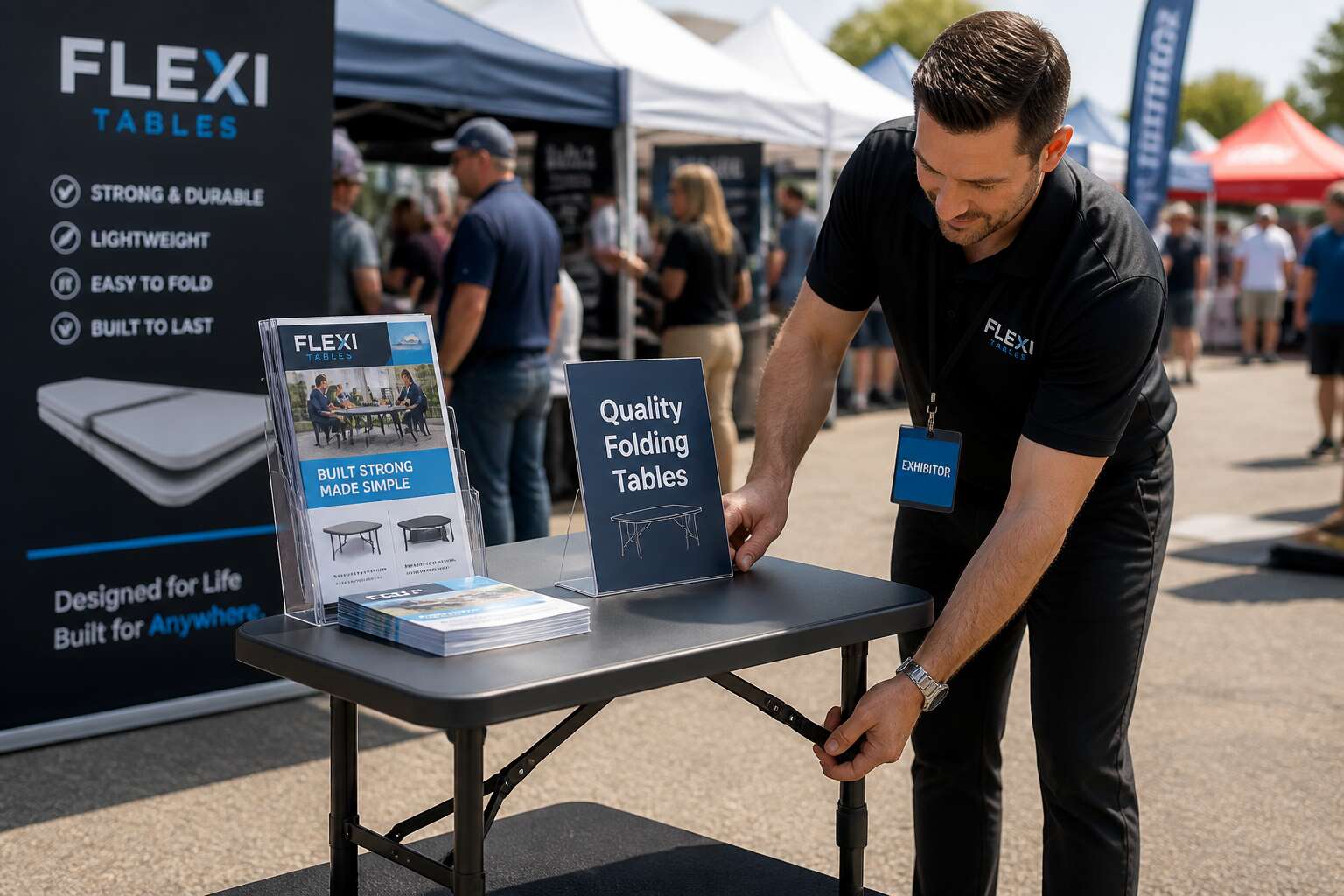
A wobbly table at a trade show is a silent sales pitch for your competitors. Portable table offerings for trade show displays must tolerate rough handling, uneven floors, and the weight of a thousand brochures. This is where product niches matter. A folding table vendor who stocks more than basic banquet models gives you options that fit the job, not the other way around.
Consider what specialised supply looks like in practice:
- Compact folding tables with adjustable legs for uneven venues.
- Slot-together display tables that assemble without tools.
- Heavy-duty portable tables with reinforced aluminium frames.
These are not warehouse leftovers. They are engineered responses to real event conditions. A folding table vendor who curates these niches saves you from improvising with hire equipment that was never designed for exhibition work. The right portable table turns a chaotic setup into a simple routine, and that is the kind of certainty your clients will notice.
Institutional Table Suppliers for Schools and Offices
Institutional table suppliers answer to different pressures. Schools need hard wearing folding tables that handle daily use and frequent stacking. Offices need portable models that store compactly between meetings. A folding table vendor who sees these as separate niches offers more than a banquet line. They supply laminate tops with sealed edges, steel frames with reinforced welds, and locking mechanisms that open without pinching fingers.
- Classroom tables with rounded corners and easy grip handles.
- Boardroom folding tables with cable management trays.
- Canteen tables with wipe clean surfaces and adjustable feet.
This is specialised supply for distinct environments. I have seen the results when a school relies on generic hire stock. When you source from a folding table vendor who stocks for schools and offices, you receive products built for the setting. That certainty matters when the supplier sits in Johannesburg and the delivery heads to a rural school in Limpopo.
Hospitality and Catering Table Sourcing Considerations
Hospitality and catering buyers answer to a different rhythm than schools or offices. A folding table vendor who serves this niche must understand service flow, not just storage. Tables move from kitchen to function room, from buffet line to banquet hall, sometimes several times in one evening.
Weight becomes a deciding factor. Catering staff carry tables up stairs, across lawns, and through narrow service corridors. A folding table vendor who offers lightweight aluminium tops with torsion bar frames reduces strain injuries and speeds up setup times.
- Heat resistant surfaces for chafing dishes
- Apron edges that prevent tablecloth slippage
- Leg locking bars that keep tables stable on uneven floors
Hygiene compliance adds another layer. Health inspectors expect seamless tops and open frames that allow thorough cleaning. The right supplier passes municipal health checks without extra work from your team.
Heavy-Duty and Industrial Table Provider Options
A forklift operator does not care about your table’s aesthetic. Industrial buyers care about load limits, weld integrity, and how many times a table survives being dragged across concrete. A folding table vendor serving this niche needs to speak in technical specifications, not colour swatches.
The heavy-duty category demands reinforced steel aprons, cam locks that hold firm under vibration, and frames that tolerate both extreme heat and freezing storage conditions. These tables often carry machinery parts, power tools, or densely packed boxes in South African factories and workshops. A weak hinge becomes a workplace hazard.
Consider what separates industrial-grade from consumer-grade:
- Gusseted leg brackets that resist twisting
- Non-marring feet that grip oily floors
- Powder-coated surfaces that withstand chemical cleaning
The right folding table vendor understands that downtime costs money. A collapsed table stops a production line. That is why reputable suppliers test beyond standard weights and offer replacement parts for years after purchase.
Sourcing Strategies for Direct Table Imports
Weighing Domestic Versus Overseas Production
The price list from an overseas factory can be a seductive thing, especially when profit margins for a folding table vendor feel tight. I have seen many a business owner get lost in that spreadsheet, dreaming of container loads arriving at the harbor. But the real cost of that dream is often paid in delays and silent communication breakdowns.
Choosing a domestic supplier offers a different kind of security. When you need a specific shipment rushed for a local event, a local team can answer the phone. They know the potholes of the local courier routes and the reality of our customs sheds. Weighing these options requires looking beyond the unit price to the true cost of your peace of mind.
Consider these factors that impact your bottom line:
– Overseas logistics require massive upfront capital to secure stock that sits on the water for weeks.
– Domestic manufacturing gives you the freedom to order smaller batches, keeping your warehouse lean.
– A local folding table vendor offers quality control you can verify with your own eyes, not through a pixelated video call.
That direct relationship often proves more valuable than a slightly lower invoice. Your reputation rests on delivering a sturdy table that doesn’t wobble, and knowing exactly where it came from is a powerful start.
Requesting and Testing Product Samples
Requesting samples sounds like a formality, but it is your only defence against a disappointing shipment. I always ask for three distinct units from the production line, not the polished showpiece. The real test happens when you unfold that table in your own warehouse, on your own concrete floor, and give it a proper shake.
A folding table vendor who hesitates to send samples is telling you something. Listen to that silence! For direct imports, I put every sample through a short checklist:
- Weld integrity and locking mechanism tension
- Table height against South African standard dimensions
- Surface durability after repeated folding and unfolding
That sample is your truth. It reveals whether a folding table vendor understands your market or simply wants your deposit.
Negotiating Payment Terms and Delivery Schedules
There is a particular dread in wiring a deposit to a factory you have never visited. The money disappears into a banking system that offers no comfort. All you hold is a signed document and the memory of a folding table vendor’s assurances. Payment terms determine whether that relationship sours or hardens.
I prefer a 30 percent deposit, nothing more. The remainder rests against the bill of lading. This arrangement distributes risk evenly. For delivery schedules, I request liquidated damages clauses. A supplier who refuses such a clause expects delay. A supplier who accepts it, and still misses the date, reveals their true reliability. Listen to the silence when a supplier avoids discussing penalties!
Negotiate both together. Cover these points:
- Percentage due at order and at shipment
- Incoterms that define who bears freight costs
- Penalty rate for each week of delay
- Tolerance window before penalties apply
A generous payment schedule without penalty invites complacency. A strict penalty without fair payment terms invites excuses.
Managing Supply Chain Risks and Backup Suppliers
Most importers learn the true cost of a missed container only after it happens. Sourcing strategies for direct table imports require mapping every step from factory floor to warehouse door. A port closure or raw material spike can halt production for weeks.
Managing supply chain risks begins with honest self-assessment. I keep two backup suppliers in separate provinces! They receive only small batches to test reliability without growing lax.
For a folding table vendor, backups must match primary quality. I verify steel gauge and weld spacing quarterly.
- One vendor offers faster turnaround, higher cost
- One vendor offers slower lead times, lower minimums
When the primary fails, I shift only the urgent fraction of an order, keeping relationships intact.
Leveraging Online Directories and B2B Marketplaces
Comparing Features of Leading Table Supplier Platforms
When hunting for a folding table vendor, the directory you choose can be as influential as the factory’s output. B2B marketplaces now offer side by side feature comparisons, which saves hours of email tennis. Some platforms prioritise price transparency, while others highlight verified reviews from South African buyers. A directory might specialise in event equipment, making it easier to locate regional stockists.
Consider these comparison points:
- Filtering options for table dimensions and load capacity
- Vendor response speed and language support
- Access to buyer protection schemes
Each platform has quirks. One may require a subscription for detailed contact info, another offers free quotes but slower response. The right fit depends on your order volume and tolerance for administrative friction. Test two or three before committing.
Interpreting Verified Badges and Supplier Ratings
Somewhere between the algorithm and the job site, trust becomes the currency of procurement. In the sprawling landscape of online directories, a verified badge is rarely a stamp of perfection. It is a snapshot, a promise measured in resolved disputes and shipped pallets. I keep a mental rubric when scanning B2B marketplaces for a folding table vendor, and it has little to do with polished profile photos.
Real utility comes from the granular details:
– The recency of the reviews, not just the volume
– Whether the vendor responds to negative feedback publicly
– The ratio of repeat buyers to first-time inquiries
A five-star rating from three orders means one thing. A four-star rating from two hundred orders with detailed commentary on weld seams and hinge durability means something far more valuable. These signals tell you if a folding table vendor understands the South African market, with its dust, its heat, and its demand for resilience. Ratings often capture the whole supply chain diapason, from packaging quality to freight coordination, in a way that sales pitches never will.
Analyzing Customer Reviews and Historical Performance
The difference between a reliable supplier and a poor one rarely appears on a directory profile page. A company can list certifications, flashy logos, and short lead times. The real evidence sits in the historical performance, the accumulated reviews from past orders that mention packaging damage, weld quality, or silent delays.
Scan for patterns across months, beyond the latest glowing testimonial. Check whether the same complaints surface repeatedly. A vendor who resolves a dispute publicly shows better accountability than one who deletes negative feedback.
- Look at review dates alongside star counts
- Count repeat buyers in the comment sections
- Compare promised lead times with actual ones
When the review archive aligns with the sales pitch, you have found a folding table vendor worth contacting.
Using Request-for-Quotes Tools to Compare Offers
Online directories offer a starting point, but the signal to noise ratio is poor. A better approach is using the request-for-quotes tools built into major B2B marketplaces. You submit one specification sheet, and competing suppliers respond with itemised quotes. That comparison exposes gaps that profile pages hide.
Send the same document to several suppliers and ask for identical information. For example:
- Request ex-works and landed cost separately
- Ask for current lead time in writing
- Confirm whether the quote includes local delivery
South African buyers should pay close attention to the last point. A folding table vendor with local warehousing quotes differently from one shipping from abroad. The comparison also reveals responsiveness, and I have found a reliable folding table vendor answers detailed RFQs within two business days while underperformers stall.



0 Comments